 K-Clinic
Facial Asymmetry Treatment Seoul: Barrrjung Hospital Guide
Facial asymmetry can be related to muscles, posture or bite, but only a doctor's examination can tell which. According to Barrrjung Korean Medicine Hospital in Seoul, you can prepare with 4 steps: note where the left-right difference is, record daily posture habits, notice your bite and chewing, and take dated photos. If one eye suddenly won't close or one mouth corner droops, seek care promptly.
Is Facial Asymmetry from Muscles, Posture or Bite? 4 Things to Check First
You can't tell by looking in the mirror whether facial asymmetry comes from muscles, posture or bite. Barrrjung Korean Medicine Hospital only states that uneven face shape or expressions can be related to muscles, posture or bite, and that the actual cause must be determined by a doctor's examination.
So what you can do before your trip is organize the information a doctor will want to know. This article covers 4 steps: check the left-right difference, record posture habits, notice your bite, and photograph and date the changes.
These observations are not for self-diagnosis. They simply mean your first consultation doesn't have to start from zero.
Step 1: Where Is the Left-Right Difference at Rest and When Making Expressions?
Stand in front of a mirror with your face relaxed and check which side is higher, lower or shifted: eyebrows, eye size, mouth corners, chin position.
Then try a few expressions: smile, frown, close your eyes, puff out your cheeks. It's worth noting whether the difference only shows when you make expressions, or is already visible at rest.
Write down what you see in one sentence, such as "my right mouth corner is lower when I smile." At the clinic, that is far more specific than "my face looks crooked."
Step 2: Daily Posture and Habits
The hospital's materials list posture as one of the directions that may be related to facial asymmetry. Before you go, think back over your daily habits, for example:
- Do you often sleep facing the same side?
- Does your head tilt to one side when you look at your phone or use a computer?
- Do you habitually rest one cheek on your hand?
- Do you always carry your backpack or bag on the same side?
These are simply common daily habits people are asked to recall. Whether they relate to your asymmetry is for the doctor to judge. There's no need to change anything yet; just write them down.
Step 3: Bite and Chewing Feel
The third direction mentioned is bite. Pay attention to whether you tend to chew on only one side, whether your upper and lower teeth feel like they meet off to one side, and whether your jaw feels like it shifts when you open and close your mouth.
Write down these sensations and tell the doctor at your visit. Whether your bite needs separate evaluation by another department is the doctor's call, so don't rule it out or assume it yourself.
Step 4: Photos and When It Started
Photos are the most useful record. Take them in the same lighting and at the same distance:
- Front view, relaxed expression
- Front view, smiling
- One photo each of the left and right sides
- If you have an older photo, find one from when your face looked more symmetrical for comparison
Also note when you first noticed it, whether it became obvious gradually or appeared suddenly, and whether there is any pain or other discomfort.
One important point: signs such as one eye not closing fully, a drooping mouth corner, or leaking when drinking are listed in the hospital's materials under facial nerve palsy, which is different from simple facial asymmetry. The hospital says treatment in the early stage greatly affects the outcome, so seek care promptly. Speed and degree of recovery vary from person to person.
How Barrrjung Korean Medicine Hospital Approaches Facial Asymmetry
Barrrjung Korean Medicine Hospital in Seoul focuses on facial conditions such as facial nerve palsy, trigeminal neuralgia and facial asymmetry. Its representative director, Jeong In-ho, is president of the Korean Facial Society and president of the Facial Palsy Research Society.
The hospital uses a combined Korean and Western medicine approach: it confirms the cause through pulse diagnosis, palpation, imaging and ultrasound before planning treatment. For facial asymmetry the listed options are balance chuna and thread embedding acupuncture, and the actual combination depends on the doctor's examination.
The related items on the price list are as follows (in Korean won, the hospital's posted non-covered prices, with tax and validity period not stated):
- Simple chuna: ₩27,000 per session (complex chuna ₩45,000; the price list states these apply "when over 20 sessions per year")
- Bone-alignment (mi-gol) chuna: ₩50,000 per session
- Manual therapy: ₩50,000 per 30-minute session
- Therapeutic thread embedding (standard): ₩5,000 per thread, minimum 2 threads per session, so ₩10,000 when simply added up
- Therapeutic thread, Scratch type ₩30,000 per thread; barbed type ₩50,000 per thread; Premium ₩200,000 per thread
Which items you will actually need and how many sessions can only be known after the examination. For fees not on the price list, such as the consultation and tests, please confirm in advance through the K-Clinic live chat.
Opening Hours and How to Get There
Barrrjung Korean Medicine Hospital is in Gwanak-gu, Seoul, and the nearest station is Sinsadang...
Frequently Asked Questions
Q: Do I have to take photos before the visit?
A: It isn't required, but it helps a lot. One front photo, one smiling photo and one of each side, plus the date you noticed it, let the doctor grasp the changes faster.
Q: What should I bring?
A: Bring your previous medical records and MRI/CT images on disc or as files. Also tell the doctor the date of onset, how symptoms have changed, and any medication you are taking, especially anticoagulants and steroids.
Q: Can I be treated if I'm only staying a few days?
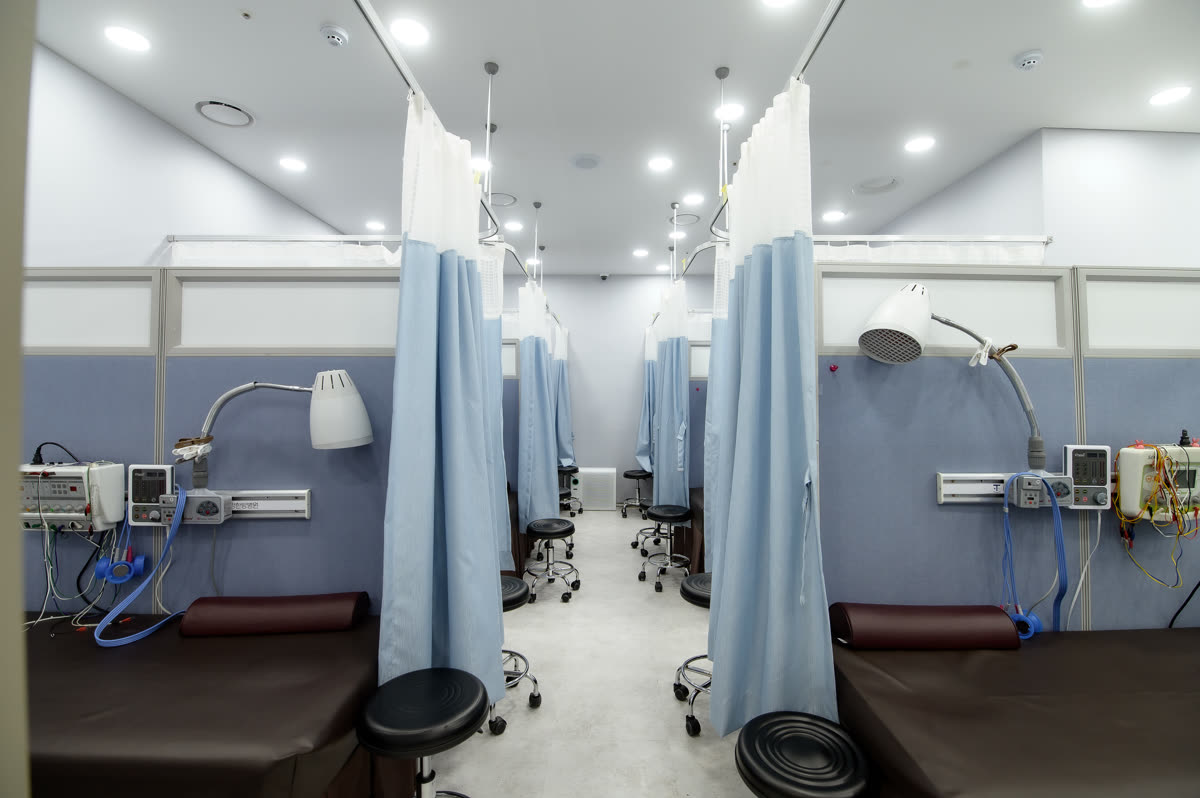
A: The number of sessions and the intervals depend on the doctor's examination. Tell us your length of stay first so we can confirm whether your schedule is enough. The hospital has a 65-bed ward, so you can also ask about inpatient stays.
Q: Is there a recovery period after chuna or thread embedding?
A: Local soreness or swelling can commonly appear after treatment. The degree and recovery time depend on the doctor's judgment, so ask the doctor to explain before treatment.
Book Barrrjung Korean Medicine Hospital with K-Clinic
The cause of facial asymmetry is hard to judge on your own. Use the Request booking button or the live chat on this website for a free consultation, so you can organize your photos and symptoms first and then arrange your visit.
We will check with the hospital:
- How many treatment sessions suit your length of stay
- Prices for balance chuna and thread embedding acupuncture, and how tax is calculated
- Fees not on the price list, such as the consultation and tests
- Available weekend or weekday dates and time slots
Once your booking is confirmed, we will send you the appointment time and the address.
Actual treatment depends on the results of the examination.
Frequently asked questions
Is facial asymmetry caused by muscles, posture or bite?
According to Barrrjung Korean Medicine Hospital, facial asymmetry can be related to muscles, posture or bite. You cannot tell the actual cause by yourself; it needs a doctor's examination.
How should I prepare before a facial asymmetry consultation in Korea?
Take front and side photos, note when you first noticed the asymmetry and whether it has changed, and pay attention to your daily posture and chewing habits. If you have previous medical records or MRI/CT images, bring them on disc or as files.
How does Barrrjung Korean Medicine Hospital treat facial asymmetry?
The hospital lists balance chuna and thread embedding acupuncture for facial asymmetry. The actual treatment and number of sessions depend on the doctor's examination.
Is Barrrjung Korean Medicine Hospital open on weekends?
Yes. It is open 09:00–15:00 on Saturdays, Sundays and public holidays with no lunch break. Monday to Friday it is open 09:00–20:00, with a lunch break from 13:00 to 14:00.
Clinics in this article
Sindaebang Station (Line 2)