 K-Clinic
Facial Palsy Treatment Seoul: Korean Phrases | Barrrjung
You can visit a Korean medicine hospital without speaking Korean if you prepare short Korean symptom phrases, your onset date, your medical records and imaging, and a translation app. "I can't close my eye" is 눈이 안 감겨요, "my mouth corner droops" is 입꼬리가 처져요, and "my face tingles like an electric shock" is 얼굴이 찌릿찌릿해요. Barrrjung Korean Medicine Hospital in Seoul focuses on facial paralysis, trigeminal neuralgia and facial asymmetry.
Short answer: save your symptoms as Korean phrases on your phone
You can see a Korean medicine doctor without speaking Korean. Write your symptoms as short phrases, save them in a phone note or screenshot, and show them to the doctor. This is more accurate than improvising with a translation app in the room.
For facial problems such as facial paralysis and trigeminal neuralgia, the doctor mainly wants to know: which side, when it started, what the pain feels like, and which movements trigger it. If you prepare these four things, most of the communication is done.
This article uses Barrrjung Korean Medicine Hospital in Seoul as an example and covers common Korean phrases and how to prepare your phone translation.
Start with these basic Korean phrases
Before describing symptoms, prepare phrases for left/right, start time, and "please speak slowly." You will use these at almost every visit.
- 왼쪽이에요: It's the left side.
- 오른쪽이에요: It's the right side.
- 3일 전부터 이랬어요: It has been like this for 3 days (change the number as needed).
- 천천히 말씀해 주세요: Please speak slowly.
- 번역기로 보여 드릴게요: I'll show you with a translation app.
The hospital asks patients to tell them the onset date and how symptoms have changed. Write the date on your phone first, then add whether it is getting worse (점점 심해져요) or better (좋아졌어요).
Facial paralysis: Korean phrases for eyes, mouth and expression
According to the hospital, typical signs of facial paralysis (a drooping or twisted face) are an eye that won't close fully on one side, a drooping mouth corner, water leaking when drinking, and an asymmetrical expression. The Korean phrases are:
- I can't close my eye: 눈이 안 감겨요
- My mouth corner droops: 입꼬리가 처져요
- My face is pulled to one side: 얼굴이 한쪽으로 돌아갔어요
- Water leaks when I drink: 물을 마시면 새요
- My expression differs between left and right: 표정이 좌우가 달라요
- I can't use force on one side of my face: 한쪽 얼굴에 힘이 안 들어가요
Pick 2–4 phrases that match your situation and put the screenshot first in your photo album. At the appointment you can show it right away without scrolling.
Trigeminal neuralgia: describing electric-shock pain and triggers
The hospital describes trigeminal neuralgia as "electric-shock-like pain on one side of the face lasting seconds to minutes, triggered by washing the face, brushing teeth or talking." To explain it clearly, focus on what the pain feels like, how long it lasts, and when it happens.
- My face tingles like an electric shock: 얼굴이 찌릿찌릿해요
- It feels like being stabbed with a needle: 바늘로 찌르는 것 같아요
- It hurts for a few seconds: 몇 초 정도 아파요
- It hurts when I wash my face: 세수할 때 아파요
- It hurts when I brush my teeth: 양치할 때 아파요
- It hurts when I talk: 말할 때 아파요
- I'm fine when it doesn't hurt: 안 아플 때는 괜찮아요
The hospital explains that telling trigeminal neuralgia apart from toothache or atypical facial pain requires a doctor's examination. You don't need to reach your own conclusion. Just describe how the pain feels and let the doctor decide.
Facial spasm and twitching: how to describe eyelid and cheek movements
Facial spasm is also among the conditions this hospital treats, and it also requires a doctor's examination. When describing twitching, focus on location and frequency.
- My eyelid keeps twitching: 눈꺼풀이 계속 떨려요
- My cheek twitches: 볼이 실룩거려요
- One side of my face moves on its own: 한쪽 얼굴이 저절로 움직여요
- It gets worse when I'm tired or tense: 피곤하거나 긴장하면 더 심해요
If you can, record a video of about 10 seconds on your phone. Twitching may not happen during the appointment, and a video is more direct than any description.
Information the doctor will ask for: prepare it in advance
The hospital suggests three things to prepare for your visit. Here they are with Korean sentences you can copy:
- Medical records from home and imaging such as MRI or CT, on a disc or as files: 해외에서 MRI를 찍었어요. 자료를 가져왔어요. (I had an MRI taken abroad. I brought the records.)
- Onset date and how symptoms have changed: 5일 전에 시작했어요. 점점 심해져요. (It started 5 days ago. It's getting worse.)
- Medications you are taking, especially anticoagulants and steroids: 항응고제를 먹고 있어요 / 스테로이드를 먹고 있어요. (I'm taking anticoagulants / steroids.)
For medications, take a photo of the pill packet or box and add the ingredient names. For treatments such as acupuncture and pharmacopuncture, the doctor needs to know what you are taking first.
One safety reminder: if facial symptoms come with weakness in your arms or legs, slurred speech or a sudden severe headache, go to the nearest hospital or emergency room first instead of waiting for an appointment. The hospital also explains that it distinguishes peripheral from central paralysis before planning treatment.
How to use phone translation so you don't get stuck
Don't wait until the appointment to open your translation app. Do these 3 things before you go:
- Translate and save in advance: Paste the phrases above into your translation app's favorites or a notes app so you can read them offline.
- Use short sentences, not long ones: Say one thing at a time. "My left eye won't close" translates more accurately than "my eyes have felt kind of strange lately."
- Show the Korean on screen: Enlarge the screen and hand it to the doctor. This is more reliable than reading it aloud.
It also helps to prepare one "symptom summary" screenshot: affected side, onset date, type of pain, triggering movements, medications and tests done at home. Show it first, then answer the doctor's questions.
K-Clinic's advice: before you go, send us this information through the Request booking button or live chat on this website, and bring the organized version with you once it is confirmed.
Check costs and length of stay before your visit
The prices below come from the hospital's published list of non-covered items. The list does not state tax or an expiry date, so these are for reference only:
- Pharmacopuncture (neutral, bamboo salt): ₩10,000–₩30,000 per vial
- Therapeutic thread embedding (standard): ₩5,000 per thread, minimum 2 threads per session
- Simple manual therapy: ₩27,000 per session (the price list marks this as the rate when you exceed 20 sessions a year)
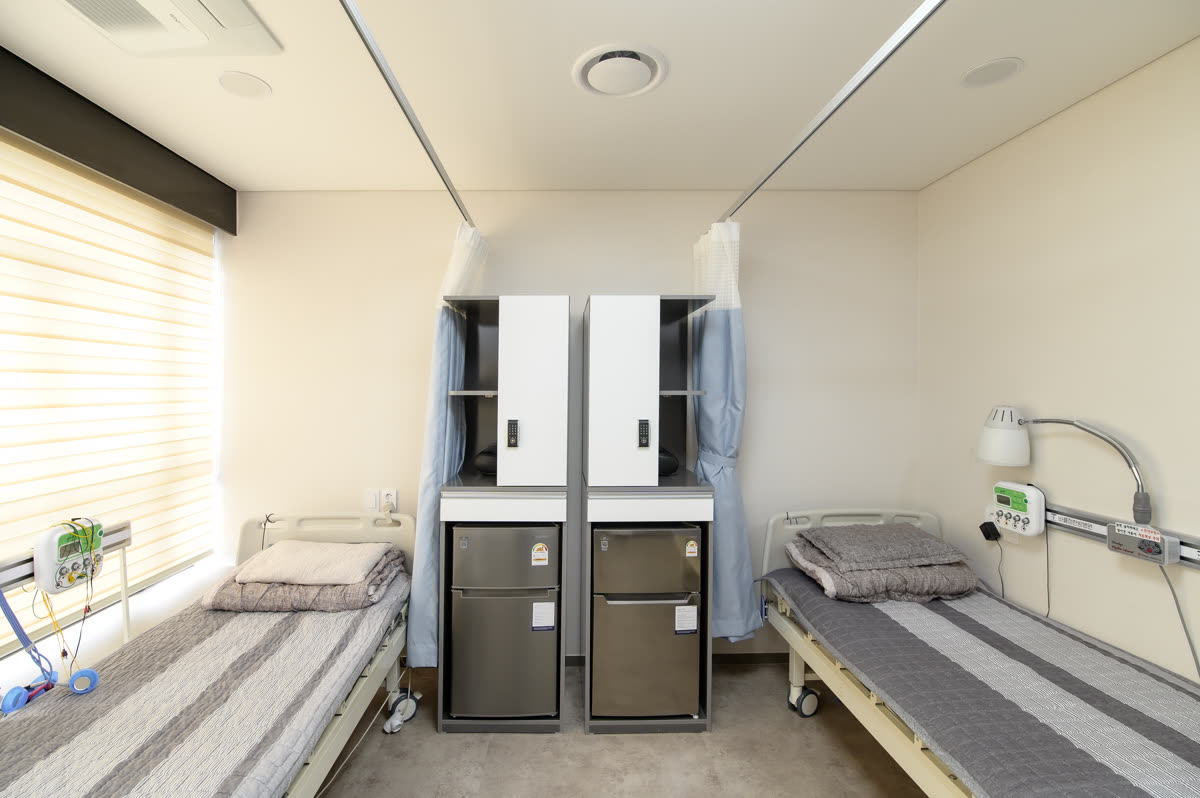
- Single-room upper-grade ward: ₩150,000 per day
For fees not on the list, such as consultation, tests and basic acupuncture, please confirm with us first through the Request booking button or live chat. The actual treatment and number of sessions depend on the examination results.
Length of stay matters too. The hospital says the number of treatments and the interval between them are decided by the doctor after examination. It has a 65-bed ward, so you can ask about admission for a short stay. Tell us your travel dates when you request a booking.
Hours and access
Barrrjung Korean Medicine Hospital is in Gwanak-gu, Seoul, with Sindaebang Station (Line 2) as the nearest station. The address is 1485 Nambusunhwan-ro, Gwanak-gu, Seoul, Samnam Building, floors 1, 7, 8 and 9.
Korean address (for taxi drivers or map apps): 서울 관악구 남부순환로 1485 삼남빌딩.
- Monday–Friday: 09:00–20:00 (lunch break 13:00–14:00)
- Saturday, Sunday and public holidays: 09:00–15:00 (no lunch break)
The hospital also sees patients on weekends and public holidays, which is convenient if you are only in Korea for a few days.
Common questions from international visitors
Q: Does the hospital have a Chinese or English interpreter?
A: The information we have does not state whether the hospital arranges interpretation, so please confirm when you book. You can do a pre-visit consultation through the Request booking button or live chat on this website, and we recommend bringing your own phone translation.
Q: I only know how to say "pain" and don't know how to classify it. What should I do?
A: Use descriptions such as tingling or shock-like (찌릿찌릿), heavy or dull (묵직해요) and twitching (떨려요), plus which side it is on. That is enough. The doctor will classify it correctly.
Q: What should I bring?
A: Medical records from home, imaging such as MRI or CT (on a disc or as files), your onset date and how symptoms have changed, and the medications you are taking.
Q: How can I confirm what to do after returning home?
A: The hospital says the doctor checks your recovery before you go home and explains precautions and the direction of follow-up care. You can ask the doctor to write this on paper or on your phone screen, then translate and save it.
Book Barrrjung Korean Medicine Hospital through K-Clinic
You don't have to manage the language barrier alone. Use the Request booking button or live chat on this website through K-Clinic for a free consultation and explain your symptoms and length of stay up front.
We will check with the hospital on:
- Which appointment time suits your symptoms and onset date
- The treatment plan within your length of stay, and whether admission is needed
- Fees for items not on the price list, such as consultation, tests and basic acupuncture
- What form your imaging and medical records from home should be in
Once your booking is complete, we will tell you your appointment time and the address.
Actual treatment depends on the examination results.
Frequently asked questions
Can I visit a Korean medicine hospital in Korea without speaking Korean?
Yes. Save your symptoms as short Korean phrases on your phone, prepare your onset date, medications and imaging files from home, and show them to the doctor. You can also use the Request booking button or live chat on this website for a pre-visit consultation.
How do you say "I can't close my eye" in Korean?
Say 눈이 안 감겨요, which means "my eye won't close." Add 왼쪽 눈이요 (the left eye) or 오른쪽 눈이요 (the right eye) to show which side is affected.
How do I describe trigeminal neuralgia pain in Korean?
Say 얼굴이 찌릿찌릿해요 (my face tingles like an electric shock), then add 세수할 때 아파요 (it hurts when I wash my face) to describe the trigger. Whether it is trigeminal neuralgia must be determined by a doctor's examination.
Is Barrrjung Korean Medicine Hospital in Seoul open on weekends?
Yes. It is open 09:00–15:00 on Saturdays, Sundays and public holidays with no lunch break. Monday to Friday it is open 09:00–20:00, with a lunch break from 13:00 to 14:00.
Clinics in this article
Sindaebang Station (Line 2)