 K-Clinic
Korea Pain Clinic: 6 Myths Debunked | Dr.Google Pain Clinic

Most myths about Korean pain clinics are wrong. At Dr.Google Pain Clinic, a herniated disc does not always need surgery: without progressive paralysis or loss of bladder/bowel control, non-surgical treatment can usually be considered first. Steroids are avoided where possible, most patients walk the same day, and the number of sessions varies by person.
Korea Pain Clinic: 6 Myths to Drop Before You Go
Many worries international patients raise about Dr.Google Pain Clinic come from myths, not from how the clinic actually works. Here is each one checked against the clinic's own treatment explanation.
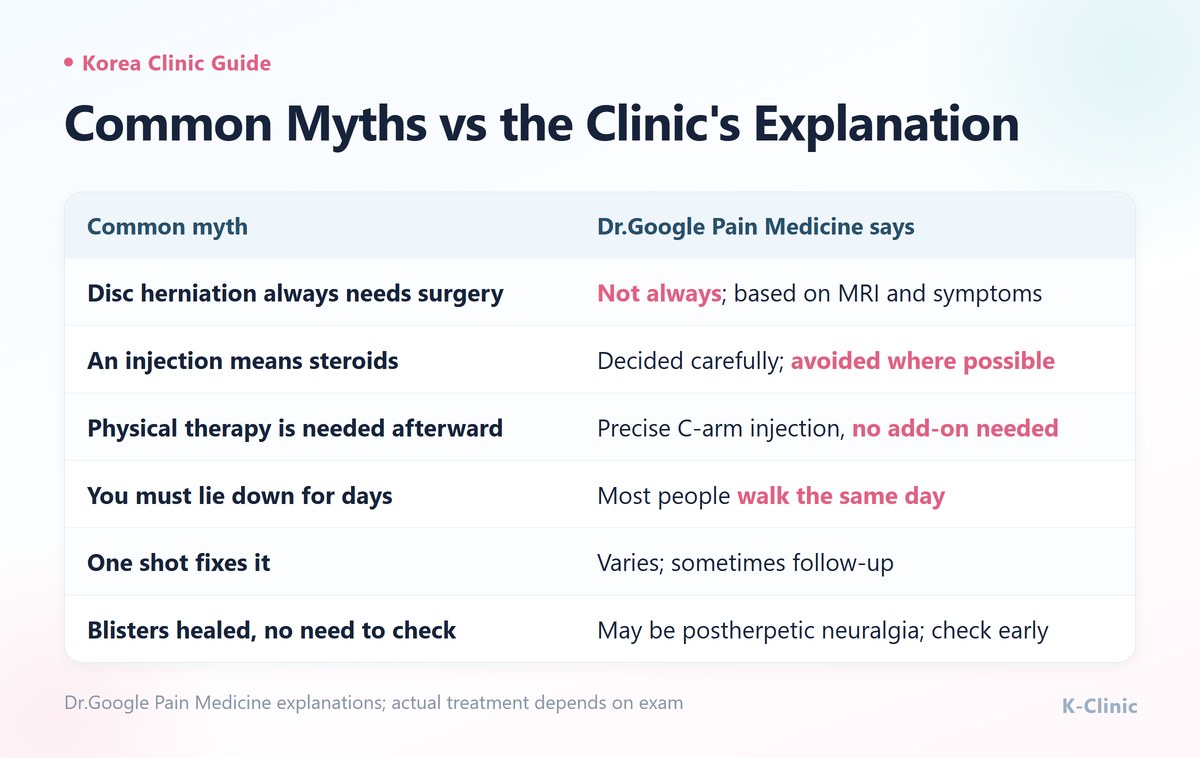
Myth 1: A herniated disc always needs surgery
Not always. Dr.Google Pain Clinic decides based on your MRI, symptoms and any loss of muscle strength. Without progressive paralysis or loss of bladder/bowel control, non-surgical options such as injections can usually be considered first.
If you have already been advised to have surgery in your home country, you can still come and hear other options. On the other hand, progressive paralysis or loss of bladder/bowel control is not a "wait and see" situation. K-Clinic recommends seeking medical care near you right away rather than delaying for travel plans.
Myth 2: Pain clinic injections are all steroids
No. The clinic's principle is that steroid use is decided carefully according to your condition, and avoided where possible. If you are concerned, ask the doctor directly what is in your injection at the visit.
Myth 3: You need separate physical therapy after the injection
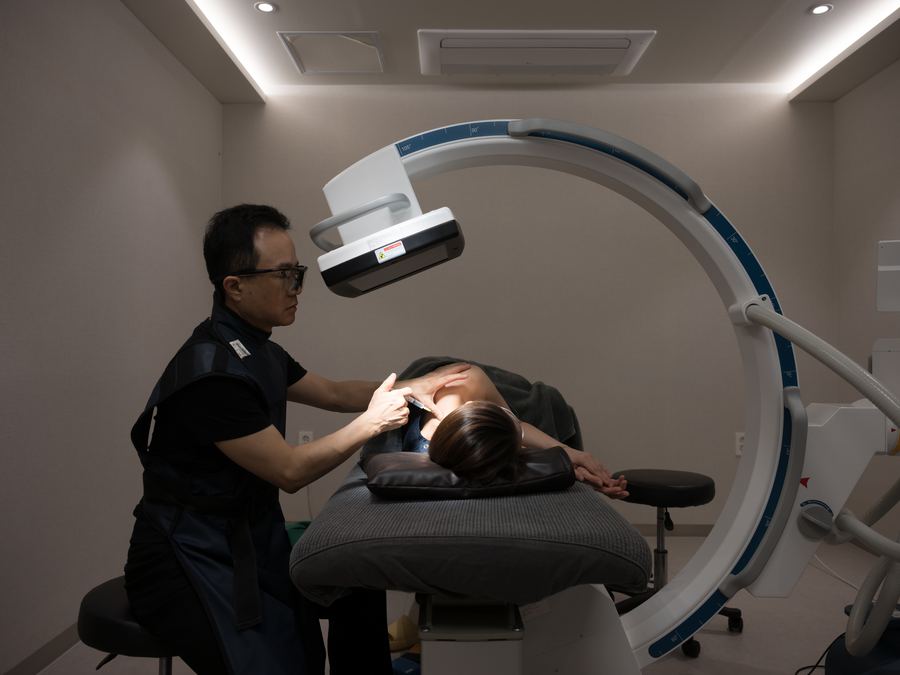
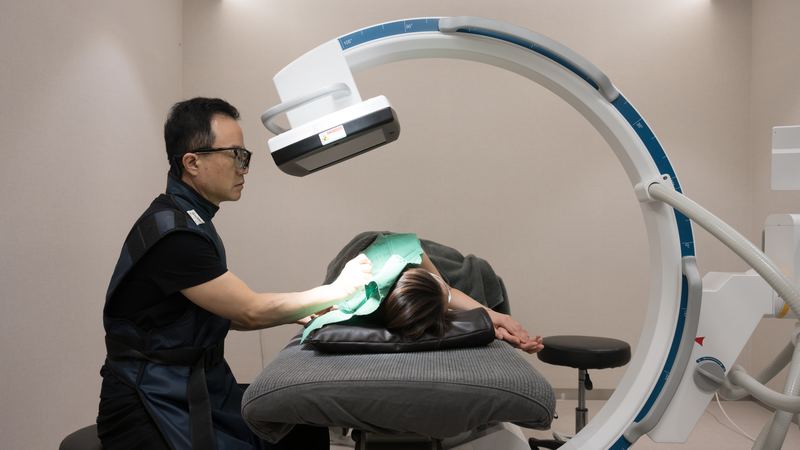
No separate physical therapy is needed. Dr.Google Pain Clinic uses C-arm imaging to confirm the nerve and treatment site, then reaches the source of pain with an ultra-fine MTS micro-needle to reduce tissue damage. The clinic states that no additional physical therapy is required.
Myth 4: You have to lie down for days and can't walk after treatment
Most patients can walk on the day of treatment. The 8th floor has hospital rooms (single and twin), and after treatment you can rest in the day ward for 6 hours or more before returning to your accommodation. If continued observation is needed, 24-hour admission is also available. Always confirm your flight time with the doctor first.
Myth 5: One injection and you're cured
Not necessarily. The number of sessions varies by person, and follow-up treatment is sometimes needed. The doctor decides whether to repeat treatment and at what interval based on how you respond. So tell us your symptoms and length of stay through the website first, let the doctor confirm your schedule is long enough, and only then book your return flight.
Myth 6: Once shingles blisters heal, you don't need a check-up
If tingling, burning or pain from clothing touching your skin continues after the blisters fade, it is often postherpetic neuralgia and should be treated as nerve pain. The clinic recommends being examined as early as possible. Depending on where the shingles occurred, referral to ophthalmology or ENT is arranged when needed.
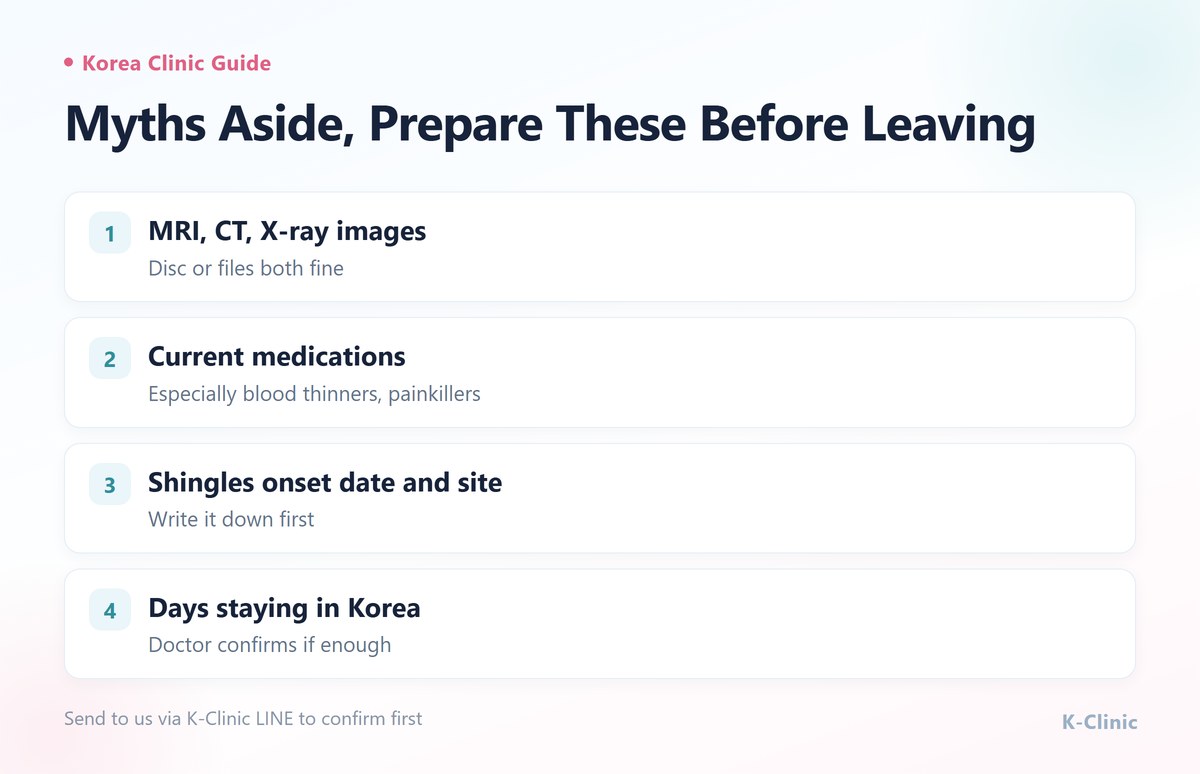
What to Prepare Before You Fly to a Korea Pain Clinic
What you need to prepare is documents, not courage. Bring your MRI, CT and X-ray images or medical records on disc or as files; tell the clinic about any medication you take, especially blood thinners and painkillers; and for shingles, note the onset date and affected area.
Opening hours: Mon and Fri 09:30–20:00, Tue 14:30–20:00, Wed 09:30–19:00, Sat 09:30–14:00. Closed Thursday and Sunday. The clinic is at Downtown Building, 214 Simin-daero, Dongan-gu, Anyang-si, Gyeonggi-do (treatment rooms on the 7th floor, hospital rooms on the 8th floor). From Seoul, take Subway Line 4 to Beomgye Station and walk about 5 minutes; parking is available in the building.
From first consultation and examination to follow-up after treatment, you are cared for personally by Dr. Koo Jae-won (MD, PhD), a specialist in anesthesiology and pain medicine.
Korea Pain Clinic FAQ for International Patients
Q. Does the pain clinic only treat the lower back?
No. Besides shingles and lumbar disc herniation, it also treats cervical disc herniation, spinal stenosis, shoulder, elbow, knee and hip pain, as well as trigeminal neuralgia and tinnitus.
Q. Is numbness in the fingers always a neck problem?
Not always. It can also come from carpal tunnel syndrome or an elbow nerve problem, which the doctor needs to examine to tell apart.
Q. Can I be treated on my first visit?
The first visit includes an interview, physical examination and imaging to identify the source of pain. If it is suitable, treatment can be given the same day.
Q. How much does it cost?
The clinic does not publish prices, so please confirm the cost at your consultation.
Book Dr.Google Pain Clinic Through K-Clinic
If you still have questions, use the "Request booking" button or the live chat on this website for a free consultation and ask what is on your mind.
Please tell us where the pain is and how long you have had it, your diagnosis and imaging from home, any medication you take, and how many days you will be in Korea. We will pass this on to the doctor, check that your schedule is long enough, and arrange your visit and day ward stay to avoid Thursdays and Sundays.
The number of pain treatment sessions varies by person, and actual treatment depends on the examination results.
Frequently asked questions
Does a herniated disc always need surgery in Korea?
No. According to Dr.Google Pain Clinic, if there is no progressive paralysis or loss of bladder/bowel control, non-surgical treatment such as injections can usually be considered first. The exact plan depends on your MRI and symptoms.
Are all pain clinic injections in Korea steroids?
No. Dr.Google Pain Clinic decides on steroid use case by case according to your condition, and avoids steroids where possible.
How many days do I need to rest after pain treatment in Korea?
Most patients can walk on the day of treatment. You can rest in the day ward on the 8th floor for 6 hours or more before returning to your accommodation, or stay 24 hours if continued observation is needed. Confirm your flight time with the doctor first.
Will one pain injection in Korea cure my pain?
Not necessarily. The number of sessions varies by person, and follow-up treatment is sometimes needed. The doctor decides whether to repeat treatment and at what interval based on your response.
Clinics in this article
About 5 min walk from Beomgye Station (Line 4)